

December 23, 2025. 8:30 a.m.
I was driving to work, listening to a psychology lecture—something I’ve been doing increasingly over the last two months as part of my ongoing quest to learn more about myself and those around me.
That’s when I heard it.
Nigredo.
The word stopped me cold. Not because I learned it, but because I recognized it.
In alchemy, Nigredo is the blackening—the first stage of transformation. The descent into darkness. The disintegration of form. The death of what once held shape.
Carl Jung later interpreted alchemy not as chemistry, but as psychology. To him, Nigredo described a necessary psychic death—the collapse of an identity that could no longer carry the Self.
Not punishment.
Not weakness.
Preparation.
I didn’t have a name for what I’d been going through over the last decade.
Until this morning, I did.
Running Before the Descent
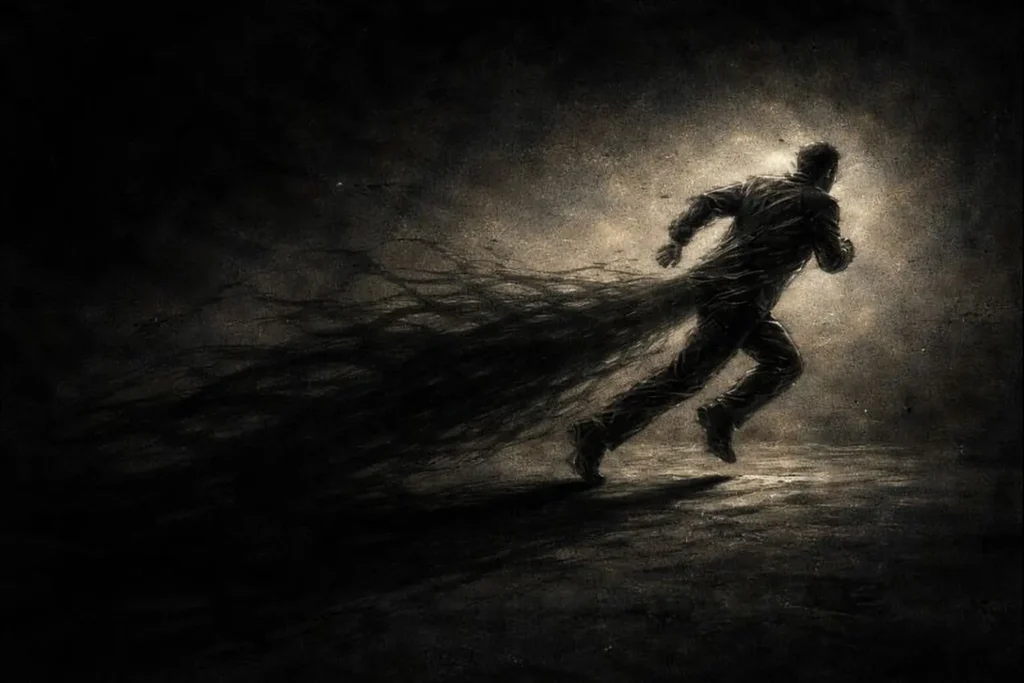
I’ve been running from something for as long as I can remember.
As a child, it showed up as mini-adventures—dragging my brother along on schemes that usually ended with us in trouble and a whooping from our mom. As I got older, the running evolved. Sports and partying became my escape. I did well in school, but I’d cut class for other activities. Anything that kept me moving outward instead of inward.
Motion felt like safety. Stillness felt dangerous.
In my early twenties, I tried launching Mifren—a social community aimed at connecting Caribbean people. It failed. Then WalkItMedia, an outdoor media company. That failed too.
But I kept moving. Kept building. Kept running.
I didn’t know then that I wasn’t avoiding laziness or lack of ambition. I was avoiding recollection. The kind that doesn’t knock politely. The kind that waits until the door can no longer be held shut.
There were two moments when I realized—consciously, in real time—that I was running from something.
The first came at a house party in my early twenties.
I was sitting on the steps inside with some friends and a couple women from the party. We were joking, laughing, and drinking. I told a joke that got everyone laughing—ended up earning me the nickname “Peanut” that night.
While we sat there, something cut through the noise and the inebriation. A moment of clarity, sharp and uninvited, like something crawling up from inside me.
A voice: You don’t want to be here.
I drank enough to drown it that night.
The second time, I couldn’t drown it anymore.
It was Halloween 2015. Downtown Fort Lauderdale. I was dressed as a Roman gladiator—drunk like one who’d just won his freedom from the colosseum.
I was so drunk I was being carried by two women from my group as we walked back to the parking lot. We stopped to get hot dogs from a vendor, sitting on some nearby steps to eat.
I sat there, floating on cloud nine, body numb with alcohol and other things.
And that’s when the voice cut through my euphoria again.
Sober. Clear. Undeniable.
I couldn’t outrun it anymore.
The Forced Stillness
But before I could stop running on my own terms, life stopped me.
It was July 2014. I’d picked up my brother to celebrate our birthdays—back-to-back days like always.
We were driving home. Crossing the intersection of Flamingo and Pines Boulevard.
Then our world went dark.
Someone ran the red light and slammed into the side of my car.
The next time I opened my eyes, all I saw were red flashing lights through blurred vision. A voice told me they’d have to cut my pants off. I said ” OK, ” my speech blurred, and then I passed out again.
I woke up hours later in the ICU at Memorial Hospital.
I’d broken all the ribs on my left side. Facial burns from the airbag. Fracture scapula. A list of other injuries that made breathing feel like negotiating with fire.
But mine paled in comparison to what my brother and girlfriend at the time went through. My brother’s aorta had ruptured. Broken ribs. My girlfriend had broken ribs, her hip, her jaw.
I spent close to two months in that hospital. Three weeks the first time. Got released. Then readmitted days later because my breathing was still inconsistent.
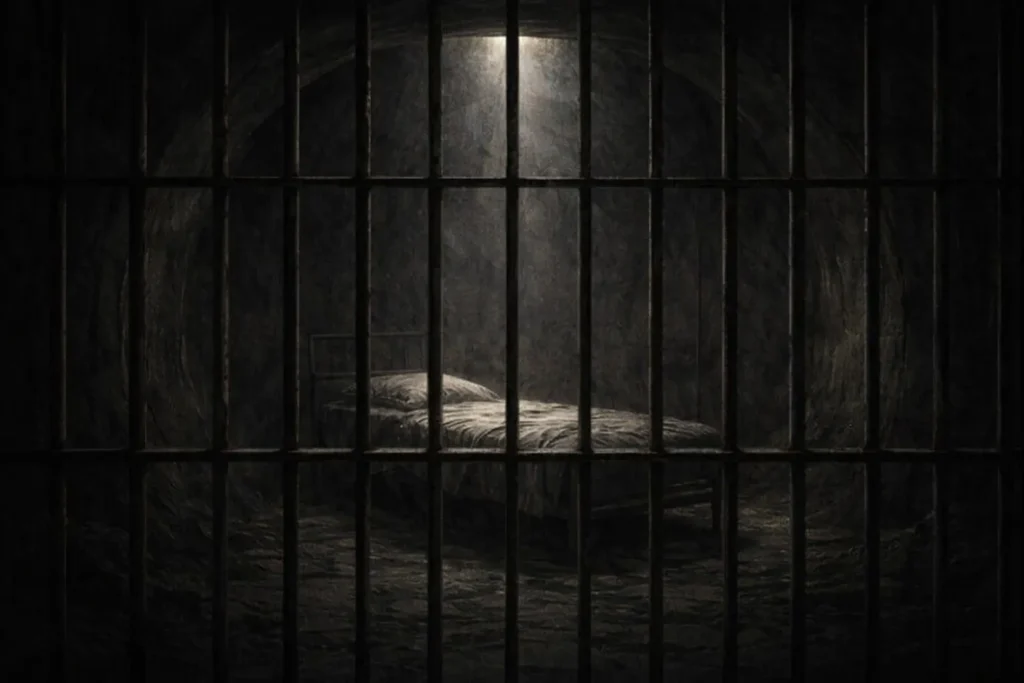
The hospital room felt like a prison.
I’d wait for my pain medication—Dilaudid—and then I’d sneak out of bed, dragging myself through the pain to check on my brother and girlfriend. The nurses weren’t fans of this. Eventually, they activated an alarm on my bed to alert them when I moved.
That became a game. Finding gaps to turn off the alarm and sneak away without being caught.
It backfired a couple of times. My pain would spike while I was away from my room, unable to make it back. Nurses from my floor would be forced to retrieve me.
My mom was at the hospital every day. That’s why I fought so hard to be released the first time—to give her some relief. At least one of her sons was getting better.
But being released didn’t free me.
I moved from being trapped in bed at the hospital to being trapped at home—away from the normal activities that gave me peace or at least distance from the thoughts that were now rapidly resurfacing.
The narcotics I got for the pain offered my only escape. Numbing my body. Taking the edge off everything that was coming to the surface.
When I got lucky, the drugs would send me into a numbing sleep for hours.
Then I’d wake up to it all over again.
What the Stillness Forced Me to See
Lying helpless in that hospital bed, unable to escape physically, my mind began doing something it hadn’t done in years.
It remembered.
With a memory sharper than I ever wanted it to be, I recalled and relived experiences I’d outrun for most of my life. Trauma resurfaced—not as stories, but as sensations. Not as thoughts, but as lived moments.
The first thing that surfaced was my father leaving. The challenges that came from that. The loneliness.
Then I realized how much anger I’d been carrying.
But what destabilized me most was this: After thinking through the situation as an older man now, I could understand the fear he must have felt. Having to take care of three children. Me now at the same age he would have been then.
Somehow, that understanding made the pain worse.
Because I compared it with myself. And I knew—without question—that I would not be able to just leave those I love.
That realization broke me during those weeks I was trapped in bed.
The hospital bed had become a sealed container. An alchemical vessel. A crucible.
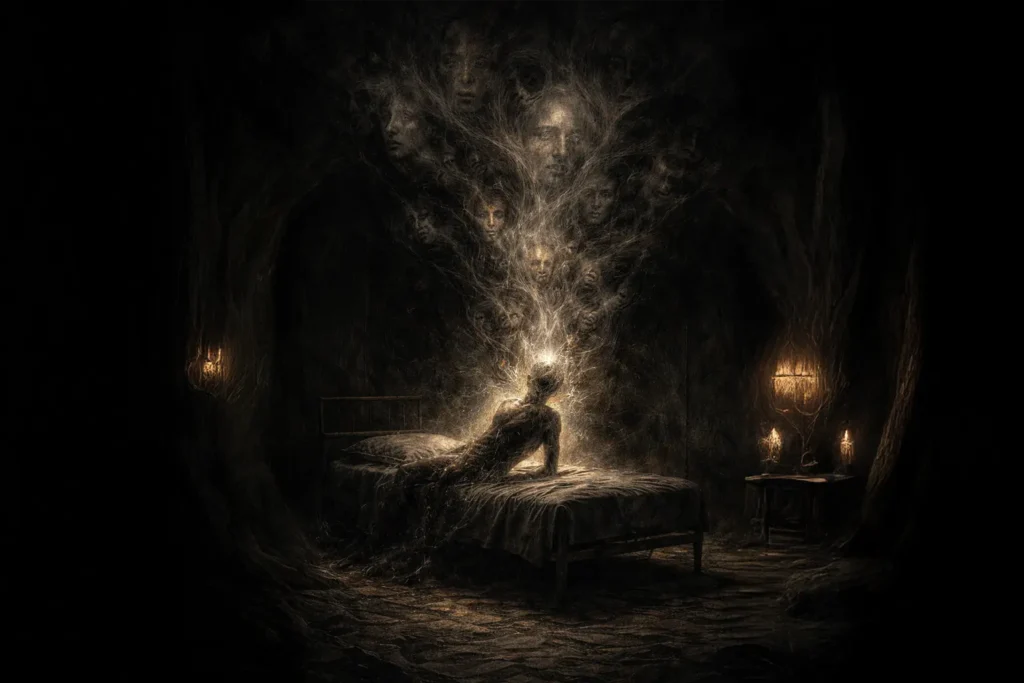
I didn’t know it then, but this was the summons—not the descent itself.
Nigredo doesn’t always arrive all at once. Sometimes it announces itself slowly, patiently, peeling back layers.
The unraveling had begun.
The Attempt to Outrun It Again
After my body healed in 2015, I went on a binge.
I tried to outrun the voices I’d been listening to for months since the accident. The Halloween moment in Fort Lauderdale—that was the breaking point. The realization I couldn’t run anymore.
But the self-destruction didn’t stop immediately. It lasted into 2016.
It acted as a distraction. One that undoubtedly took me off my game—weakened the foundation I was building for ChairsAhoy, my furniture drop-shipping company.
Maybe if I’d been more focused, I could have built a stronger foundation, had some kind of contingency. Maybe I could have prevented its implosion at the end of 2016 into early 2017. Maybe I could have turned the company around.
I’ve written about this collapse in detail in The Sanctuary from the Abyss—the full story of how the business imploded, how I fell into depression, how anxiety turned into panic attacks.
What I didn’t write about there was the context.
ChairsAhoy didn’t just fail because of external factors. It failed because I was already unraveling. The descent had started in 2014 in that hospital bed. By the time 2017 came, I was already halfway into the void.
This was the true Nigredo.
Not just the business collapse. Not just the depression. But the complete dissolution of meaning.
Nothing in my life made sense anymore.
Jung wrote that when meaning collapses, the ego experiences it as annihilation—because meaning is what holds identity together.
That’s exactly what it felt like.
The Quiet Void
Eventually, the panic lifted. The anxiety faded. Around seven months after the collapse, a sense of normalcy returned.
But I was no longer who I had been.
I felt like a stranger in a strange world. Stable—but detached. Functional—but disoriented.
This is the phase no one warns you about.
After the death of the old self, before the birth of the new one, there is a quiet void. An interregnum.
Many people rush to fill it—new identities, borrowed beliefs, louder lives.
I didn’t.
I stayed.
For years—2017 through 2020—I stayed in that quiet void.
I worked. I went to the gym. I wrote. I existed the only way I knew how.
But more importantly, I continued going back internally. Learning what was there. Learning how to understand it. Learning how to mend it.
I came out of my isolation after 2020, into 2021.
Ironically, as the world began to fall apart.
As I’ve detailed in When the Arena Goes Dark, my body kept trying to force me to stop through CSCR—stress-related vision loss that hit me three times. My body was telling me what my mind refused to accept: slow down, or I’ll make you.
And as I wrote in The Man I Needed to Become, part of what I was mending in that void was the father wound—the 11-year-old boy who waited outside Manning’s High School for a man who never showed.
All of it—the hospital bed, the business collapse, the vision loss, the father wound—was Nigredo.
The blackening. The descent. The necessary psychic death.
What Nigredo Took
Nigredo took from me:
- The illusion that effort guarantees outcome
- The fantasy that intelligence protects you from collapse
- The belief that motion equals progress
- The hope that unresolved wounds could be outrun
- The version of me who believed he could hold everything together, alone
It dismantled me completely.
What Nigredo Gave
Only after loss did something else emerge.
Humility.
Depth.
Patience.
Comfort with solitude that developed into a need for it.
A tolerance for ambiguity.
Authority without dominance.
I’ve written before about the three paths men take when they grow up without fathers or in chaos: hyper-masculine aggression, fragile masculinity, or self-forged masculinity.
I worked to forge myself into the third.
But we all remain stained by our past in some way.
Why This Matters
I believe every man, regardless of background or ambition, will face his own Nigredo.
Some enter it consciously. Others resist it until it arrives as destruction.
There is no bypass.
You will either face the unsavory parts of yourself—integrate them, come to terms with them—or wait until they converge into your undoing.
This is not a threat. It is consequence.
Nigredo does not ask if you are ready. It only asks if you will stay.
If you find yourself in the wreckage right now—lost, disoriented, stripped of meaning—know this:
You may not be broken.
You may be in Nigredo.
And if you stay long enough, if you resist the urge to run or numb or distract yourself back into motion—something honest will eventually emerge.
Not brighter.
Not louder.
But real.
More you.

The Final Credits
I’m working through the final credits of this phase now.
That letter to my younger self released a psychic weight that I’ve been carrying. Holding on to. But now released.
Entering a new one where I want to share what I’ve learned—so that it might help even one person recognize their own Nigredo before it destroys them.
Or, if they’re already in it, to know they’re not alone.
To know there’s a name for what they’re going through.
To know that the blackening is not the end—it’s the preparation.
The death of what you were is painful.
But it makes space for what you’re becoming.
And sometimes, that’s the only way forward.