
There’s a weight that settles on you when you’re breaking, a gravity that doesn’t care about physics or logic. It just pulls. And pulls. Until you’re on your knees in the middle of a street, wishing a car would finish what your mind started.
I know because I’ve been there.
Let me tell you about the year I almost didn’t make it. The year the gym became the only thing that offered me refuge after being chewed up and spat out by the abyss.
The Collapse
December 2016. I shut down ChairsAhoy—my furniture drop-shipping company that had been my first real taste of success after failing at multiple business ideas.
The collapse wasn’t dramatic. It was bureaucratic. Clinical. A poorly built product sold through Amazon got returned by multiple customers. Perceived defect. My performance scores tanked. Amazon froze my seller account—and the funds sitting in it.
Everything I’d built evaporated overnight.
I’d failed before. Multiple times. But this was different.
It didn’t just capsize my finances. It gutted my confidence. It shook loose everything I believed to be true about my life, my abilities, my fate. I went from having steady income to burning through what little I’d saved, unable—or maybe unwilling—to find a job.
For the first month, I told myself I’d figure it out. That’s what I always did. I was resourceful. Resilient. I’d bounce back.
But a month turned into two. Then three. And something inside me started to unravel.

The Trinity of Survival
The gym became my sanctuary.
Not in some metaphorical, “exercise clears your mind” way. I mean it literally saved my life.
But it wasn’t my only lifeline during those months when I was coming apart at the seams.
Writing became my self-therapy. Late nights when I couldn’t sleep, early mornings when the weight on my chest wouldn’t let me rest, I would write. Not for an audience. Not for purpose. Just to process what I couldn’t speak out loud. To untangle the knots in my mind by putting them on paper where I could see them, name them, sometimes even understand them.
And then there was Foodiwant.
I’d conceived the idea a few months before ChairsAhoy crashed—back when I still had a plan. The plan was simple: build ChairsAhoy’s revenue up a bit more, sell it, and use the proceeds to birth my real vision. A marketplace and community for the restaurant industry. Something transformative.
When ChairsAhoy evaporated, that plan died too. But the concept? That stayed alive in my head. And during those darkest months, when my present felt unbearable and my past felt like a graveyard, Foodiwant became my escape into a future that still felt possible.
I had no money. No timeline. No team. But I could research. I could tinker. I could build the parts of it that didn’t require resources—just imagination and stubborn belief that maybe, just maybe, there was still something ahead worth building toward.
The gym sustained my body, writing steadied my mind, and Foodiwant preserved my hope.
But the gym—the gym was my weapon.
The Iron Sanctuary
I went 5-6 times a week, sometimes twice in a day. Early mornings, before 7 a.m., when the world was still dark and I could pretend I was the only person in it.
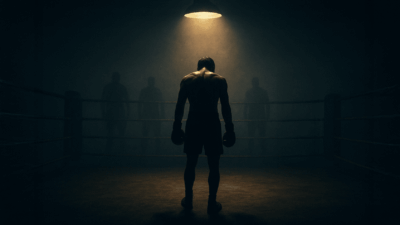
I lifted heavy. Dangerously heavy. Heavy compound movements—squats, deadlifts, bench press—pushing to failure, beyond what felt like my limit. I’d train until I was dizzy. Until nausea crept up my throat. Until the physical pain and exhaustion tore me from my internal prison and dragged me into that singular moment.
In those moments, everything that was building up inside me—the anger, the regret, the doubt eating at my core—found an outlet. It seeped through the cracks just enough to prevent me from completely imploding.
I was channeling all the shards of myself into a single point of focus, reassembling the broken pieces like kintsugi—that Japanese art of repairing pottery with gold. Except my gold was fury. And sweat. And the refusal to let this be the thing that ended me.
Science would later tell me what I already knew instinctively: resistance training reduces anxiety symptoms by 20-30%. Heavy lifting triggers endorphin release—natural opioids that dull emotional pain. Physical exhaustion interrupts the rumination cycles that trap you in spirals of catastrophic thinking.
But I didn’t know any of that then. I just knew that in the gym, I could still lift heavy things. And if I could do that, maybe—just maybe—I wasn’t completely broken.

The Wave
It was about a month after I shut down the website when the first anxiety attack hit.
I’d lost my apartment by then. I was staying with a woman I was seeing, trying to piece together some semblance of normal life. One afternoon, I walked across the street to visit a good friend—just a few minutes away on a back street in Tamarac called The Commons.
The visit was fine. I played the part. Pretended to be my old self. They knew I’d had a setback, but not how I was really feeling. Not that I was barely holding it together.
On the walk back, everything seemed normal. And then, out of nowhere, the wave hit.
No warning. I can’t even remember my mind drifting to any particular thought. I just suddenly felt heavy. With every step, heavier. Like someone was turning the dial on gravity, cranking it up degree by degree.
I was almost across the street. Maybe two more steps to the curb.
But I couldn’t.
The weight got too heavy. I fell to one knee.
My vision blurred with tears. My chest tightened. I couldn’t breathe right. I was breaking right there in the middle of the street.
A couple minutes later, at the corner of my eye, I saw a car swerve around me. It didn’t stop. Just kept driving.
And a faint thought ran across my mind:
I wish it had just hit me. End this quickly.
I stayed on that knee for about 10 minutes—though it felt like hours—until I found the strength to force myself up. My front door was less than 50 yards away.
It felt like 1,000 miles.
The Checkout Line
The attacks didn’t stop. They got worse.
The next time, I was standing in line at Publix, waiting to pay for groceries. Just essentials—I was barely eating like my normal self. There were maybe three people ahead of me.
And then I felt it again. The wave. The weight.
I can’t remember ever in my life having to fight so hard to remain whole. To not break right there, falling to pieces with no way to reassemble, right there on the checkout line at Publix.
I couldn’t allow that to happen.
I fought with every cell in my body. I could feel myself trembling with tension, holding everything in place through sheer force of will.
I’ve squatted 500+ pounds. But that felt like a warm-up compared to whatever this was. The weight of past, future, and present all coordinating at once, crushing down on my chest, my shoulders, my spine.
No one noticed. The cashier didn’t look up. The people around me kept scrolling on their phones, tossing groceries onto the conveyor belt, living their normal lives.
I made it outside.
But it was weeks before I left my place again—except to go to the gym.
I couldn’t put myself in that position again. I couldn’t risk breaking in public, in front of strangers who wouldn’t understand. Who would just see a man falling apart and not know that he was fighting a war no one else could see.
Those weeks felt like the longest of my life. Time was stuck in a capsule that oscillated between going viciously slow to blindingly fast and crowded.
The Lifeline
What I didn’t know then—what I couldn’t have known—is that this wasn’t just about ChairsAhoy.
This was an accumulation. Three and a half years of unprocessed trauma, maybe even a lifetime from being an emotional hoarder, starting with a car accident in 2014 that nearly killed me. I broke all the ribs on my left side, suffered burns on my face from the airbags. My brother ruptured his aorta. My girlfriend at the time broke ribs, her hip, her collarbone. We all survived, but something in me stayed broken. Unprocessed. Waiting like a ticking time bomb.
The implosion of my business was just the last straw—a heavy one—on this camel’s back.
I was swinging between numbness and feeling everything flow in and out at once. I was unraveling, and I had no idea how to stop it.
Then I found a video.
I was searching the internet for help—desperate, late at night, typing variations of “how to deal with anxiety” into the search bar—and I came across a video on YouTube by Patrick Bet-David titled “How to Deal with Anxiety Attacks and Depression.”
Patrick, if you ever read this: I’m eternally grateful you made that video.
He opened by telling his own story. He was an entrepreneur who’d had anxiety attacks while building his business. It got so bad he ended up in the hospital. He wasn’t speaking from theory or academic distance. He’d been in the trench with me.
The part that clicked most was his breakdown of depression versus anxiety.
Depression, he explained, is about the past. Regret. Loss. Things you can’t change.
Anxiety is about the future. Fear. Uncertainty. Things you can’t control.
That distinction gave me a weapon.
It didn’t stop the attacks in their tracks. But it gave me clarity. It helped me identify the enemies I was fighting and how to fight them. It armed me with information that allowed me to rebuild myself just enough to get steady, to get out, to get more help.
I watched it again. Took notes. And for the first time in months, I felt like I had a map—even if the terrain was still impossible.

The Rebuild
The rebuild wasn’t fast. It wasn’t clean. It wasn’t triumphant.
It was slow. Messy. Built on small rituals that felt ridiculous at the time but turned out to be the foundation I desperately needed.
After I got a job and health insurance, I started seeing a therapist. She wanted to prescribe Xanax within the first sessions. Pills to numb the problem, not understand it. I took the prescription. Went to a few sessions and stopped going.
Instead, I built my own system.
I found a simple reminder app—meant for to-do lists—and filled it with affirmations that would pop up throughout the day:
- Forgive yourself.
- You will repair and rebuild.
- You are enough.
- You will figure this out.
- This will not stop you.
I started consuming lectures by Dr. Jordan Peterson, a clinical psychologist whose blunt, direct way of speaking about chaos and meaning helped me install frameworks that became my foundation.
One of those frameworks was simple: Make your bed every morning.
It sounds absurd. Trivial. But that action—spreading my bed, tucking the corners, starting my day with one completed task—gave me a foundation to lay the rest of my day on. Even if everything else fell apart, at least my bed was made.
At least I’d done one thing right.
For the next three years, I remained in survival mode. Introspecting. Getting to know myself. Learning what self-awareness actually meant beyond the buzzword.
And then something strange happened.
In 2020, when the entire world locked down and fell apart, when everyone else started to panic—I began to feel at peace.
The world was finally matching my internal state. And somehow, in that chaos, I found my calm.
The Gold in the Cracks
Self-awareness was the gold in my kintsugi.
The gym saved my body. Writing saved my mind. Foodiwant saved my hope. But self-awareness—brutal, unflinching honesty about who I was and what I’d survived—rebuilt my soul.
Now, I see my scars as both beautiful and functional. Battle scars from my war with reality. A war for my sanity and my entire self.
I feel like a war tank driving next to Priuses. They’re fine. Efficient. Built for smooth roads. But I survived terrain that would have crushed them. And that changes you.
Entrepreneurs are 2x more likely to suffer from depression and 3x more likely to struggle with substance abuse than the general population. 72% of us are affected by mental health issues, compared to 48% of everyone else.
We don’t talk about it enough—especially men. We’re told to keep grinding, suck it up, to “crush it,” to post our wins and hide the bruises.
But the truth is, chasing dreams isn’t all light. There’s a darkness that comes with ambition—the kind that visits in quiet moments and makes you question why you started at all.
The gym didn’t heal me. It became a rhythm in the silence, keeping me breathing long enough to face myself—to rebuild what the grind had broken, and to remember that survival itself is sometimes the first step toward healing.

If You’re Reading This
If you’re in the middle of it right now—if you’re fighting a war no one else can see, if you’re holding it together in checkout lines and crossing streets and pretending you’re fine—I need you to know something:
You’re not broken beyond repair.
You’re in the fire. And fire doesn’t destroy everything. Sometimes it just reveals what’s strong enough to survive. It forges a better you.
Find your anchor. Maybe it’s the gym. Maybe it’s writing, running, building something with your hands. Maybe it’s a video on YouTube at 2 a.m. that reminds you that you’re not insane—you’re just human.
Build small rituals. Make your bed. Write down affirmations that feel stupid until they don’t. Find the people—or the voices—that speak your language.
And give yourself time. Years, if that’s what it takes.
Because here’s what I know now that I didn’t know then:
The weight doesn’t disappear. You just get stronger.
Strong enough to carry it. Strong enough to keep walking. Strong enough to look back one day and realize you survived something that should have destroyed you.
And that makes you a war tank too.
…
Author’s Note
If you or someone you know is struggling with anxiety, depression, or suicidal thoughts, please reach out:
- National Suicide Prevention Lifeline: 988 (Text or Call)
- Crisis Text Line: Text HOME to 741741
- Language: English, Spanish
Resources mentioned:
Patrick Bet-David: How to Deal with Anxiety Attacks and Depression